
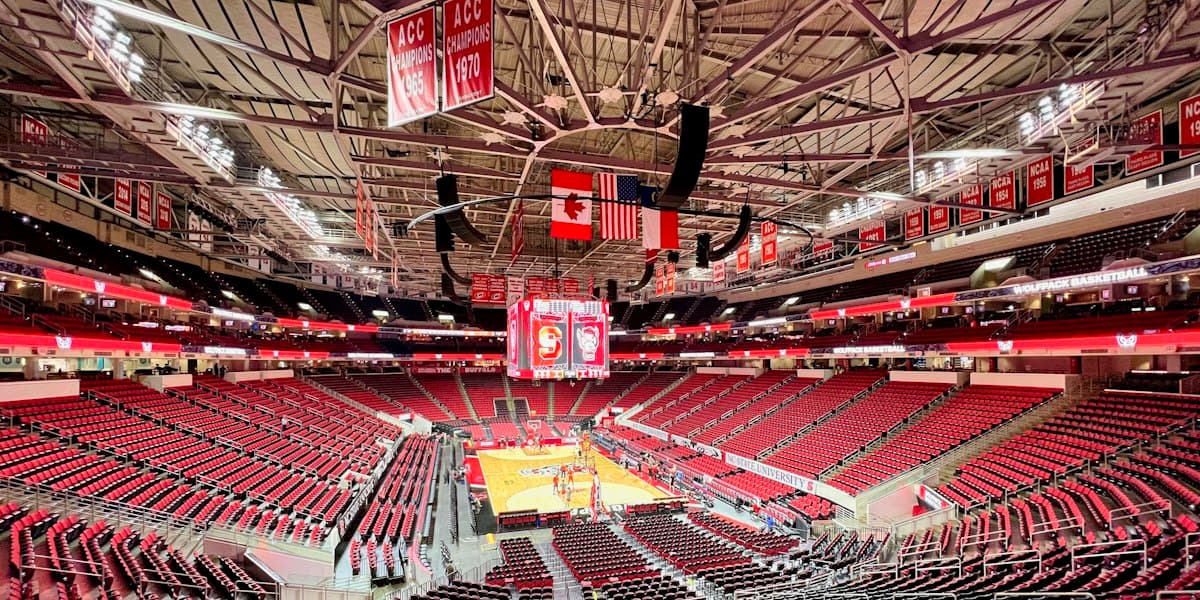
Capacity is not availability
A 12,000-seat arena two to three hours from three major metros reads as supply on every concert input. Its two anchor tenants are sports franchises — and no concert dataset carries the calendar.
Capacity Is Not Availability: Peoria’s 12,000-Seat Arena Is Also Home to D1 Basketball and Minor-League Hockey
October 11, 2026 · 7 min read
A promoter sizing a secondary market runs three checks: how big the room is, what comparable acts did there, and which concerts are already on the calendar.
All three are concert instruments. In a civic-center market, the thing that takes your date is a hockey game.
Capacity is a property of the room. Availability is a property of the room’s other business — and no concert dataset carries it, including ours.
The room reads as open
On every input a market read can see, Peoria grades as supply. Peoria Civic Center opened in 1982 and is “essentially three major venues in one complex” (Pollstar, 2026-08-28).
The arena seats 12,000. The Prairie Home Alliance Theater holds 2,200. The convention center carries “more than 110,000 square feet of contiguous exhibit space,” plus a 27,000-square-foot ballroom and 17,000 more in meeting rooms.
New GM Beau Sutherland sells the geography the way a routing agent would hear it: “Geographically we’re in a prime position. We’re in Central Illinois, two to three hours away from … Chicago, Indy, St. Louis.” (The interview says “four major metro areas” and then names three. Take the three you can name.)
The building is well capitalized, too: $90 million in capital improvements since 2007, plus a two-year campaign of $47 million just finishing. The interview does not say whether the second figure sits inside the first, so they do not add.
A 12,000-seat room at drive-in distance from three major metros, kept current. On a capacity screen, that reads as an open date.
The arena’s two anchor tenants are sports franchises
The same paragraph that gives you the 12,000 seats tells you who else is in the room. The arena “is home to NCAA Div. 1 Bradley University basketball and the SPHL Peoria Rivermen hockey team in addition to hosting concerts, family entertainment and community events.”
Anchor tenant, here, means the sports franchise — not a competing show. The distinction is worth drawing because we have already written the other one.
In Charleston +24, New Orleans +22 we argued that a stadium anchor — two nights by another act in the metro’s biggest room — reshapes the dates around it and belongs in your underwrite, down to widening your Sell-Through assumption. “The weekend is spoken for either way.”
That argument stands, and this is not a re-run of it — and neither is it a re-run of the World Cup taking 11 US stadiums off the board, where the event that takes the room is also not a concert.
Each of those cases has a single counterparty. A competing stadium concert announces itself in an On-Sale Window and later a box-office report. A tournament publishes a match schedule — and even there, our own World Cup post sends you past it to the specific venue’s window, because the handover that takes a stadium offline starts before its first match.
Peoria’s tenants publish too, and reading them is the free first pass. Bradley announced its full 2026-27 schedule on September 16 — “17 times inside Carver Arena between preseason exhibitions and regular season contests” (Bradley Athletics). The Rivermen put out home dates on June 17: “30 home games during the regular season, though only 29 home dates have been confirmed as of Wednesday [June 17]” (Peoria Rivermen).
Both tenants call the room Carver Arena; the Pollstar interview never names it, so treating the two as one room is this post’s identification rather than a claim either source makes.
Different units, different as-of dates, so those two counts do not add. What they give you is the nights already gone. What nobody publishes is the union — two tenant schedules in one arena, two more rooms keeping their own books, and the holds the building is carrying around all of it, assembled into one answer about one room on one night.
Sutherland never characterizes concert availability at that arena, and the piece states plainly that the room hosts concerts. What it establishes is the tenancy.
That NCAA Division I basketball and SPHL hockey run winter schedules is ordinary knowledge about those leagues rather than a finding from the article — and that inference is the point: in the months those leagues play, a date in that arena is a date the building has to find around two tenants.
The calendar load is real, and its unit is not a show count
The complex runs a calendar load its own GM counts in event days rather than in events. Asked whether he stays busy, Sutherland gives two numbers, and both carry qualifiers that have to survive: “We hosted 221 events at the convention center last year,” and “…I think it was 500+ event days last year between the three venues.”
The 221 is convention-center only. The 500+ is the GM’s own hedged recollection in an interview — I think — counted in event days, across three rooms, and it is not a published operating statistic.
Do not convert it. An event can occupy several days, the interview never defines the unit, and Sutherland describes rooms running at once: “You may have the symphony going on, then we have a hard rock concert going on in the arena.” There is no divisor that turns 500+ event days into shows, concerts, or a share of the building’s year.
“Last year” stays unpinned as well. The only fiscal framing in the piece belongs to Pollstar’s own question, which credits Sutherland with making 2025 “the strongest fiscal year” in the venue’s history, “for convention center performance and overall venue revenue.” He does not repeat it in his answer, and it is not a claim about concert business.
What survives the caveating is still the point. This is a busy building, and most of what makes it busy is not music. In the same answer, Sutherland names the room that carries the live-entertainment load, and it is not the arena: the 2,200-seat theater is “definitely the workhorse of the three venues from a live entertainment standpoint.”
Every instrument in a market read is looking at concerts — ours included
Comparable Shows are prior events by similar artists in the same market, and a Bradley home game will never be one. The same is true of every other signal in the stack.
Our own risk pipeline is explicit about its scope. It flags a competing event on “similar genre shows in same market within 90 days,” or on a “user-provided competing show context”; saturation on “too many same-genre shows this season”; capacity mismatch on “venue size vs demand signal mismatch.” The one calendar class it may raise from general knowledge is festivals and holidays — a hard conflict like SXSW or New Year’s Eve.
So, plainly: the Promoter Brief does not surface a venue’s non-music calendar. It grades the market. It does not tell you whether the building is free. A Market Fit Score of A on a market whose one arena-scale room is already held by its tenants is still an accurate read of the market, and still a date you cannot have.
That is a data-availability fact, not a feature gap about to close. Tenant schedules and convention bookings are not in concert datasets. A building’s announced events may be on its website; the holds competing with yours are not, because a hold is an informal reservation rather than an announcement.
Reading another act’s date-adds can rank your markets by demand depth. None of it tells you the room is free.
Ask the building
Peoria is an existence proof, not a benchmark. Sutherland says as much: “There are not a lot of venues like this around the country, especially in cities our size.” Do not carry 500+ event days to another market as a rate. It is evidence that the constraint can be large, not a figure about anywhere else.
We have written about new rooms arriving — 30-plus new sheds landing in the capacity band your Brief is sizing. This is the inverse: a room already counted in supply whose calendar is already spoken for.
The transferable move is a two-step, and the second step is the one most promoters skip. Before you place a market hold on a secondary-market room, pull the tenants’ published home schedules — they are free, and they rule out the obvious nights.
Then ask the building’s booking contact what those schedules cannot show: which of your remaining nights are already committed or held for non-music business, which of those are firm, and what the other rooms in the complex are carrying. Ask about the specific room, because a three-room complex runs three calendars.
That call is worth making, because buildings in this position are choosing. “Our approach to programming is not to put events on in the venue,” Sutherland says, “but programming that makes sense for the event planner, the promoter, the artist, the show.” That is a conversation, not a lookup.
Grade the market with data. Get the date from the building.
Run your first booking brief
Ask any question about an artist, market, or venue. Callboard.fm delivers a full booking brief — risk flags included — in minutes.
Start Free Trial →