
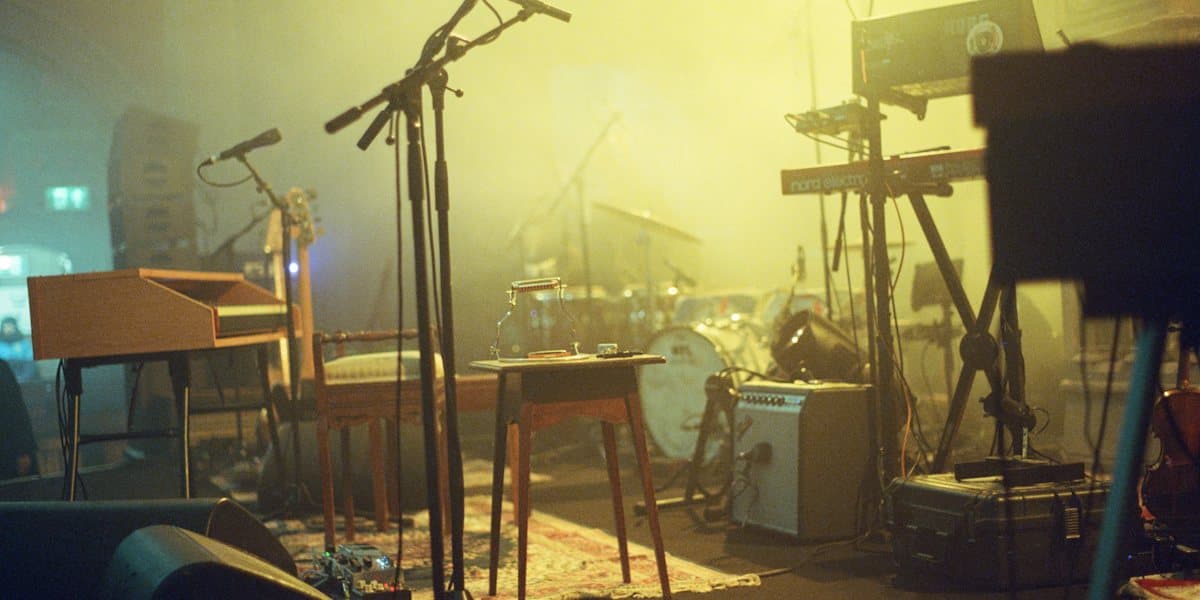
The most expensive lines in a rider have no dollar figures in them
The gear you can count. The lines that move a settlement carry no equipment and no price — a load-in time, or a phrase that quietly hands a number to somebody else.
The Most Expensive Lines in a Rider Have No Dollar Figures in Them
September 22, 2026 · 7 min read
A promoter reading a rider looks at the gear list first. The gear list is the cheapest part of the document.
The lines that move a settlement are the ones carrying no equipment and no price — a load-in time, or a phrase that quietly hands a number to somebody else. They cost money because they start clocks and require people, and neither of those things looks like a cost while you are reading.
This is the part of the artist rider that gets skipped. The gear you can count. The rest you have to read for.
The rider tells you which lines are negotiable, in its own words
You do not have to guess which lines will flex. The artist’s own drafting marks the negotiable lines, and it marks them consistently.
Take a real one. Shot of Poison, a touring Poison tribute act, publishes its full contract rider, revision dated February 2026. Tier scopes every rider figure in this post: this is a small-room tribute act, so the $25.00 meal buyout and the eight-person ceiling you will meet later are that act’s own numbers rather than an industry range.
It asks for “(2) 100 watt Hi Gain Tube amps - EVH or Marshall or equivalent,” a “Rock Drum Set (Tama, Pearl, DW or equivalent),” a “Fender Precision bass or equivalent,” and an “SVT (or equivalent)” bass head with an “8x10 Bass cab (or equivalent) 4x10, etc.”
Every one of those lines is a brand preference with an escape hatch written into it by the person who wants the gear. A backline line that says or equivalent is telling you the brand is a preference and a comparable piece will do — which may well be the piece your room already owns, and that is a question you can answer out of your own stock before you price the show.
Now read the lines in the same document that carry a bare number and no alternative: a “24-channel tour-grade digital mixing console,” “5 stage monitors (minimum of 4 channels),” a “Minimum stage size 20' x 20',” a drum riser “8' X 8' with a 6-18 inch rise.” No hedges. Those are load-bearing, and they are load-bearing for a reason you can verify — the rider’s own input list populates 20 of its 24 channels, and the drum kit alone takes ten of them.
That is the test. A line hedged by the artist is a line you can trade against a higher guarantee.
A line stated as a bare number is a line the show is built on, and the only question left is whether your room already meets it. The tech rider is where that sorting happens, and your own inventory list is the other half of it.
The clock lines cost more than the gear lines
The line that does the most to set your labor bill has no dollar sign in it: “Venue must be available for load-in at least 3 hours prior to doors-open time to accommodate proper setup and sound check.”
A rider sets your labor clock, and the house rate card prices it. Neither document shows you the number, because the number only exists once you put them side by side.
Published house rates make that concrete. The Carolina Theatre of Greensboro — 1,095 fixed seats — states that “All labor is billed at $22/hour, plus a 9.5% charge for FICA and Insurance,” and that “Minimum crew call is three-person with a two-hour minimum for the auditorium.” Before anyone touches a case, opening the door costs $144.54.
The same sheet says “Time worked after eight hours or after midnight is billed at time and a half,” and that a call meeting both conditions bills at double time. A three-hour load-in requirement pushes the whole call toward those thresholds, and a club load-out routinely lands on the wrong side of midnight.
Center Stage Theater in Santa Barbara publishes the same structure with different triggers. Its published Technical Director rate is $28 an hour basic, $42 overtime and $56 double time; the Theater Supervisor runs $20, $30 and $40. Overtime starts “after 8 hours in one day, between midnight and 8am, after 5 hours without a 1 hour meal break,” and double time runs “after 12 hours in one day or for working on any of the following 8 recognized holidays: New Years Eve after 5pm, New Years Day, Easter Sunday, Independence Day, Labor Day, Thanksgiving Day, Christmas Eve after 5pm, and Christmas Day.”
Read that overtime clause again. That meal break belongs to the house crew rather than the band, which is precisely why it gets missed — a promoter reads the hospitality rider looking for catering costs while the expensive meal clause sits in the venue’s own rate card, pushed toward its trigger by a load-in time the artist wrote.
That holiday list is a promoter’s calendar. A New Year’s Eve show in that room puts the Technical Director on the $56 rate from 5pm onward, and you knew the date before you knew the act.
Gear lines drag labor lines behind them
An equipment ask is usually a staffing ask wearing different clothes.
Sometimes the rider says so outright. Shot of Poison’s load-in section reads: “Depending on venue and load-in conditions, stage hands will be required if distance to stage is greater than 50 feet, has staircases, or if deadlifts over 2 feet are required.”
That sentence prices your loading dock. The fifty-foot trigger is the one you can walk off with a tape measure, and the staircase and the deadlift are just as knowable. The identical rider adds no bodies in a room that trips none of the three and adds them in the room next door that trips one — and you know which room you have before you make the offer.
Carolina bills every one of those bodies at $22/hour plus the 9.5% charge, which is $24.09 an hour all in, and its sheet adds that “There is a two-hour minimum on all labor calls.”
The rest of the document hides the same ask in plainer places. A “16-input digital monitor console” needs somebody standing behind it. The rider asks for “1 (A1) level audio tech or house engineer available for FOH support and/or to mix monitors,” and puts a second body in the lighting section — “pro-grade stationary and intelligent lighting along with Lighting Director.”
And the staffing number may not be yours to set. Center Stage reserves “the right to determine minimum staffing at all events, at the expense of the Licensee.” You are agreeing to a crew size the building will decide later.
A deferred price is a negotiation you will hold after you have signed
Two hospitality lines in the same rider behave in opposite ways, and the difference is worth more than either number.
The first: “The buyer may opt not to provide meals and instead provide a Meal Buyout payment of $25.00 per band/crew member to be paid at time of meal.” The document never states a party size, but it does state a maximum — the dressing room must “accommodate up to 8 people,” and the lodging clause books rooms “for up to 8 people.” Eight is a ceiling, so $200 is the most that line can cost you, and you can work that out before the offer goes out.
The second: “The buyer may opt instead for a Lodging Buyout at a price to be determined during the show advance.”
A named number is a cost. An unnamed one is an exposure. The meal line has a ceiling you can compute today. The lodging line has no endpoint in the document at all — it commits you to settle a price during advancing the show, after the guarantee is signed and the On-Sale Window has opened. That is the weakest negotiating position available to you, and the rider scheduled you into it.
Every phrase reading to be determined during advance is a number someone else will set once you have stopped being able to walk away. Close them at the offer, even roughly, even at a figure that favors the artist slightly.
Find the same cost late and it can land about 44 times harder
Here is what the timing is actually worth.
A guarantee deal at the theater level settles as a waterfall, as we have laid out before: net box office pays the show’s expenses, then the artist guarantee, then a promoter-profit line commonly set at 15% of expenses, and whatever survives is the overage — which splits 85% to the artist, 15% to you.
Follow one rider dollar through it. Priced into the budget at the offer, that dollar raises expenses by $1.00 and the promoter-profit line by $0.15, and it cuts the overage by $1.15 — of which your share is $0.17. Your net cost is about two cents. The artist’s side of the waterfall absorbs the other ninety-eight.
Now take the same dollar when it arrives outside that budget. It lifts nothing and moves no split point. Your net cost is one dollar — roughly 44 times what the identical line costs when it goes into the offer instead.
Three honest limits on that. Two are structural: it holds on a show that reaches overage under a formal split point, which our own booking-offer walkthrough puts at artist fee plus house nut plus promoter profit — below that line you absorb the cost either way — and in a flat-guarantee club there is no waterfall to push a cost into at all, which makes the guarantee number itself the only lever you have.
The third limit is the one carrying the weight, so here it is plainly. That spread is between a cost inside the settled expense base and a cost outside it. The gap is structural; timing decides which side of it you argue from.
A cost you find at the advance and get accepted onto the settlement sheet behaves like a budgeted one. The reason to price the rider at the offer is that acceptance is a favor you are asking after the guarantee is signed, and asking is a weaker position than agreeing.
Read the next rider once for its hedges and once for its clock. Put both numbers into the guarantee before the offer goes out.
Run your first booking brief
Ask any question about an artist, market, or venue. Callboard.fm delivers a full booking brief — risk flags included — in minutes.
Start Free Trial →